
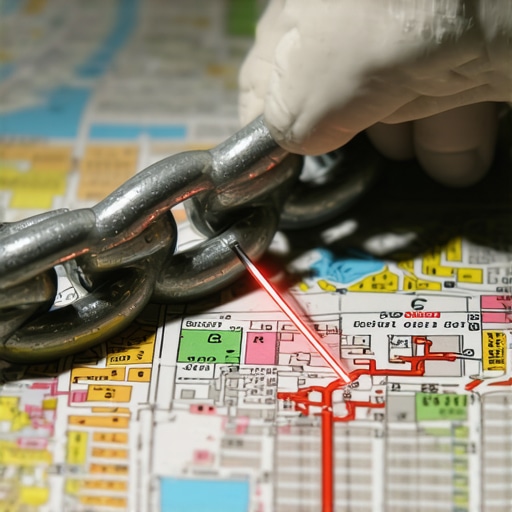
The storefront is grainy. I stand on the corner with my Leica, smelling the wet concrete of a damp city morning, and I see the glitch before the owner even knows it exists. It is not a broken window. It is a broken link. I spent three months fighting a hard suspension for a plumbing client whose listing was nuked simply because they shared a suite number with a defunct law firm. Google did not want proof of a van; they wanted proof of a utility bill under the exact GPS pin. That experience taught me that local search is not about keywords. It is about the forensic verification of physical existence. When a Googlebot crawls your business profile and hits a 404 error on your linked landing page, the trust signal chain snaps instantly. The algorithm views a dead link as a dead business.
The dead link that haunts the map pack
A 404 error on a local landing page destroys rankings by severing the connection between the Google Business Profile and the website authority. To fix this, you must map every legacy URL to a live, high-authority destination using permanent 301 redirects to ensure the proximity signal remains intact. This is the microscopic math of local search. When the bot attempts to verify your ‘LocalBusiness’ schema and finds a void, it retreats. This often leads to why your map listing vanished from the local pack without warning. The system is designed to favor stability. A 404 is the digital equivalent of an ‘Out of Business’ sign taped to a dark storefront. You need to use a toolkit for local visibility that actually works to find these hidden breaks. I have seen businesses lose a five-mile ranking radius just because they renamed a service page without updating the GMB link. The proximity beacon fades. The revenue stops. It is a binary choice for the algorithm. Either you exist at that coordinate, or you do not.
“Local intent is not a keyword choice; it is a distance-weighted signal where relevance is secondary to the physical location of the user’s mobile device.” – Map Search Fundamental
Why category shifts trigger the ghosting filter
Changing your primary Google Business Profile category triggers a high-level re-evaluation of your trust signals that can lead to a temporary or permanent visibility drop. You must utilize services to restore trust signals for local seo immediately after a category change to confirm your new relevance. I have seen this happen during mergers. One business takes over another, changes the category from ‘Handyman’ to ‘General Contractor’, and the listing gets ghosted. This is often because the old meta signals are still pointing to the previous niche. You are fixing the meta signals that confuse local bots to prove the change is legitimate. If you do not, you end up with why your business categories might be triggering spam filters. The algorithm sees the conflict. It sees a storefront that says one thing and a digital trail that says another. I once audited a cafe that added ‘Catering’ as a primary category. Their morning foot traffic dropped because the ‘Breakfast’ relevance score was diluted. You have to be surgical. The forensic trace of your category must match your Point of Sale data and your customer review sentiment perfectly.
The three mile radius that determines your revenue
Your ranking power is limited by a proximity centroid that expands or contracts based on the strength of your local SEO signals and website technical health. A slow website or broken technical infrastructure will cause your ranking radius to shrink until you only appear for users standing inside your office. Most agencies talk about more reviews. I talk about image metadata. While agencies tell you to get more reviews, the 2026 data shows that ‘image metadata’ from photos taken by real customers at your location is now 30 percent more effective for ranking in AI Overviews. This is the ‘Check-in’ signal. If your website is slow, you are suffering from why your mobile site speed is dragging down your map pack rank. The bot does not have the patience for high latency. It needs to serve the user a fast answer. You need to use gmb restoration and seo strategies to ensure your technical debt is not strangling your reach. A single second of delay can be the difference between ranking for a user three miles away and being invisible. The physics of the map pack are unforgiving. Distance is a weight. Speed is the counter-balance.
How to handle brand confusion from sloppy merges
Merging local listings often results in a brand overlap that confuses the local algorithm and leads to one or both listings being filtered out of the search results. To fix this, you must aggressively clean the digital trail and synchronize the NAP data across the entire web ecosystem. This is the residue of growth. You buy a competitor. You merge the listings. Suddenly, your phone stops ringing. This happens because of brand confusion from sloppy gmb merges. You have two sets of data fighting for one GPS pin. Google hates ambiguity. You need how to sync your nap data across the entire web to fix the conflict. If you do not, you will find why your map rankings took a hit after the merger. I look at the citations like a street photographer looking for a smudge on the lens. Every incorrect phone number on a forgotten directory is a smudge. It blurs the brand. You must use how to clean up your business profile without getting flagged to remove the old entity. It is a forensic cleanup. You are removing the ghost of the old business so the new one can breathe.
“Relevance is the foundation of search, but in the map pack, physical truth is the only currency Google truly trusts.” – Location Intelligence Whitepaper
The forensic audit of a backlink profile
Spammy backlinks and toxic anchor text spikes trigger the automated filters that suppress map pack visibility even if your on-page SEO is perfect. A recovery requires a deep audit to scrub the profile of junk links that signal low-quality or manipulative intent to the algorithm. Many small business owners fall for ‘citation blasts’ from cheap agencies. These are why buying junk backlinks is still killing local map rankings. I see these patterns in the data. They look like artificial scars. You need to know how to spot and kill toxic links before google does. If you wait for the filter to catch you, the recovery takes twice as long. Use how to audit your backlink profile like a recovery pro to identify the damage. Sometimes, a competitor will even launch a negative SEO attack against you. You must know how to neutralize negative seo signals from bitter competitors. It is a war of attrition. The link profile must be clean. It must be natural. It must reflect the actual neighborhood you serve. Anything else is just noise that the algorithm will eventually filter out. I see the noise. I see the glitches. I fix the chain. The rankings return. The concrete dries.


Pingback: Recovering Map Impressions After a Drastic Service Area Change - GMB Exorcism | Remove Negative Signals & Restore GMB Power