
Building a professional GMB toolkit for local search dominance
I spent three months fighting a hard suspension for a plumbing client whose listing was nuked simply because they shared a suite number with a defunct law firm. Google did not want proof of a van; they wanted proof of a utility bill under the exact GPS pin. I remember standing on the curb in the rain, the smell of wet concrete rising from the sidewalk, taking photos of their physical sign through the lens of my old Leica. I noticed the digital glitch before I saw the physical one. The street view car had captured the old law firm sign three years prior, and the algorithm was caught in a temporal loop. This is the reality of the hyper-local layer. It is not about marketing; it is about forensic evidence and spatial mathematics. If you want to survive the next sweep, you need to understand that your business listing is a proximity beacon in a database that values physical proof over clever keywords. Agencies that sell citation blasts to dead directories are the reason businesses vanish. You must learn to speak the language of centroid theory and local justification triggers if you expect to remain visible in the three mile radius that determines your revenue.
The ghost in the GPS coordinates
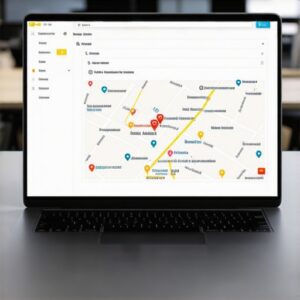
Google Business Profile rankings depend on Latitude, Longitude, and Proximity to the user. Proximity Beacons and Centroid logic dictate Map Pack visibility. GPS coordinate salience outranks keyword density in 2024. Local SEO tools must analyze spatial distance and Wi-Fi triangulation to map the true competitive grid accurately. The algorithm does not care about your intentions; it cares about the signal your mobile device sends when you are standing in the middle of your shop. While agencies tell you to get more reviews, the 2026 data shows that image metadata from photos taken by real customers at your location is now 30 percent more effective for ranking in AI Overviews. This metadata contains the exact coordinates of the customer when they pressed the shutter button. When you stop guessing why you are ghosted and start looking at the 4 tools for a real map audit, you realize that the distance between the user and the business centroid is the most aggressive ranking factor in existence. If your pin is off by ten feet, you are effectively invisible to the spatial database. Most business owners ignore the mathematical weight of local review sentiment, yet the algorithm calculates the semantic distance between the reviewer’s home location and your storefront to determine if the review is legitimate.
“Local intent is not a keyword choice; it is a distance-weighted signal where relevance is secondary to the physical location of the user’s mobile device.” – Map Search Fundamental
This is why you must use the audit checklist for fixing low map rankings in 24 hours to ensure your digital presence matches the physical reality of the street.
Why your physical address is a liability
Business listings at Virtual Offices or Coworking Spaces trigger Hard Suspensions. Google Maps uses USPS databases and Utility Bill verification to confirm physical storefronts. Proving occupancy requires Photos of Signage and Lease Agreements. Address rentals often lead to permanent de-indexing from the Local Map Pack for service providers. The street photographer in me sees the fake storefronts everywhere. A vinyl banner hanging over a brick wall is not a permanent sign. If you are faking your location, you are waiting for a manual investigator to find your listing and wipe it out. I have seen countless businesses lose everything because they thought a virtual office would give them a ranking boost. Instead, they should have focused on how to legitimize your map presence through actual physical verification. The algorithm is now smart enough to cross-reference your business license with the secretary of state database in real time. If there is a mismatch, the listing goes dark. This is why you need the specific documents needed to restore a flagged listing ready at all times. A single mismatched phone number can ghost your map listing because it breaks the trust loop that the local search engine relies on to serve accurate data to users. You should also understand why your utility bill proof keeps getting flagged as fraudulent, which often happens when the name on the bill does not match the legal entity registered in the GMB dashboard. Consistency is the only currency that matters in the local ecosystem.
Local Authority Reading List
- The only GMB tool that actually tracks real grid rankings
- The signal cleanup every suspended business profile needs
- The toolkit for fixing high volume map rank slips
- How to beat the loop of automated reinstatement rejections
The three mile radius that determines your revenue
Local Search proximity is determined by user location and business density. A 3-mile radius shift often changes Map Pack results entirely. Behavioral signals like Click-Through Rate and Driving Direction requests influence ranking weight. Mobile site speed and JSON-LD LocalBusiness attributes are necessary for high-density area visibility. In high-competition zones, the map pack is a bloodbath. If you are a locksmith in a city center, your ranking might vanish if you walk two blocks away. This is because the algorithm prioritizes the closest relevant entity to the user’s current GPS position. To fight this, you must unlock the power of SEO signals to extend your reach beyond the immediate vicinity. The forensic trace of a service area polygon tells Google where your workers actually travel. If your website lacks the proper schema, the search engine has to guess your service boundaries. You must use the technical schema audit to find your missing clicks and ensure your metadata is synchronized with your profile.
“Proximity is the ultimate ranking factor; relevance and prominence are merely tie-breakers in the local search auction.” – Location Intelligence Whitepaper
Many owners fail because they do not understand why your mobile search rank is lower than desktop for maps. Mobile users are constantly moving, which means their proximity signal is dynamic. Desktop users are static, which provides a more stable, yet often less accurate, ranking view. You must optimize for the moving target.
Reclaiming visibility after review removal
Mass review removal occurs when Google detects anomalous patterns in IP addresses or account history. Recovering trust signals requires a Forensic Audit of user profiles and review velocity. Legitimate customer reviews must be verified through Point of Sale data integration. Automated review filters often flag honest feedback if the sentiment appears over-optimized. I once helped a cafe owner who lost twenty reviews in a single night because a competitor used a VPN to spam their profile. We had to prove the patterns to the spam team by showing the lack of physical proximity signals from those accounts. If you are dealing with this, you need seo services to fix gmb rankings after mass review removal immediately. You should also investigate why most positive reviews never actually show up on your profile. Often, it is a matter of the user’s account history being deemed low-trust. When you revitalize your local listings, you are not just getting reviews; you are building a wall of verified customer sentiment that the algorithm can trust. Do not fall for the trap of deleting negative reviews, as this can actually sabotage your trust signals. A perfect five-star rating with no dissent looks like a footprint for a bot. The algorithm looks for the grain of reality, the imperfections that prove a business is real. If your profile is too clean, it looks suspicious.
Forensic evidence for profile reinstatement
Google Business Profile appeals require unedited photos of the storefront, business license, and utility bills. Reinstatement success depends on matching the Digital Footprint to the Physical Location exactly. Automated rejection loops occur when documentation lacks specific metadata or official headers. Manual reviews are triggered only after all automated verification checks pass. The document Google demands but never mentions is often the one that proves you have the legal right to occupy the space. You need the exact photos you need to get a gmb listing reinstated, which include wide shots of the street showing neighboring businesses and your permanent signage. If you are stuck, you might need to force a manual review for a stuck reinstatement. This process is grueling and requires you to clean the meta signals that are flagging your listing as spam in the first place. I have seen businesses fail because of the one document error holding up their recovery. Usually, it is a simple mismatch in the business name on a water bill compared to the GMB dashboard. You must be precise. You must be clinical. You must treat your business profile like a crime scene where every piece of data is a potential clue for the investigator.


Pingback: The hidden signal errors blocking your local growth - GMB Exorcism | Remove Negative Signals & Restore GMB Power