
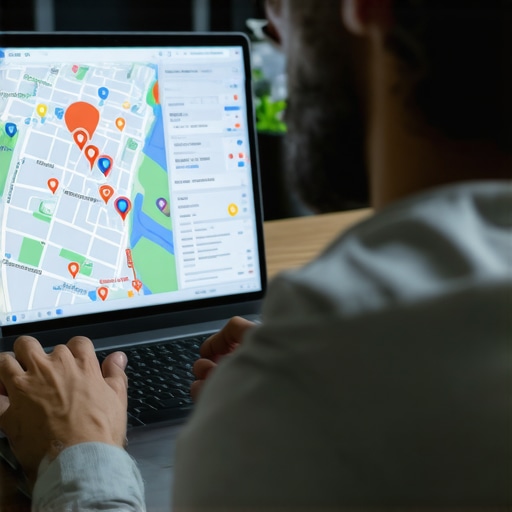
The dangerous illusion of global metrics in local spaces
Standard search volumes are mathematically divorced from geographic reality because they aggregate search behaviors over massive state-wide or national territories, rendering them completely useless for precise hyper-local positioning. These tools completely overlook physical coordinates, user movement patterns, and real-time proximity shifts. They feed you generalized data that leads directly to wasted marketing spend and empty storefronts.
As a veteran local search strategist and former map-spam investigator, I have watched countless small businesses run their marketing off of spreadsheet numbers that mean absolutely nothing at the street level. I smell the wet concrete of real, physical neighborhoods. I see the glitches in Google’s storefront database every single day. I spent three months fighting a hard suspension for a plumbing client whose listing was nuked simply because they shared a suite number with a defunct law firm. Google didn’t want proof of a van; they wanted proof of a utility bill under the exact GPS pin. That experience taught me that Google does not care about your broad keyword lists. They care about physical, verifiable reality.
“Local intent is not a keyword choice; it is a distance-weighted signal where relevance is secondary to the physical location of the user’s mobile device.” – Map Search Fundamentals
The databases powering the most popular online search software pull from broad API scrapes. They show you search volume for a ten-mile radius or an entire metropolitan statistical area. They completely miss the microscopic behavioral zooming of a consumer standing on a specific corner looking for immediate services. A customer looking for a plumbing contractor in a residential block behaves entirely differently than a corporate buyer in an office park. When you buy local seo tools for gmb, you are often just purchasing a repackaged version of these same national database scrapes. They do not tell you which specific alleyway is blocking your signal or why a competitor across the street is dominating the map pack.
The ghost in the GPS coordinates
The local search algorithm processes user latitude and longitude to construct a dynamic, highly volatile proximity boundary that renders traditional search volume tools completely blind. When a user initiates a search, the map pack adjusts dynamically within fractions of a mile based on real-time device movement. Traditional database tools cannot track this level of spatial volatility.
I have audited hundreds of profiles that were completely invisible despite having perfect keyword metrics on paper. The business owner is often stuck trying to understand why your business profile is stuck on page two when their keyword tool says they should be winning. The answer is almost always a lack of spatial entity authority, not a lack of keyword occurrences. Google reads real-world coordinates. If your physical address is grouped with ten other businesses in a shared suite, the algorithm filters you out. You might think you have an optimization problem, but you actually have a spatial positioning problem. This is why we often have to explain the truth about shared office spaces and business profile bans to owners who were misled by generic software recommendations.
The mathematical weight of a review is also highly dependent on where the reviewer actually was when they wrote it. A review submitted by a verified customer standing directly inside your shop carries significantly more weight in the local entity graph than a review left by someone hours away. Traditional keyword planners ignore these spatial validation signals completely. They simply count characters and assume all search volume is created equal.
The three mile radius that determines your revenue
A business listing acts as a proximity beacon whose organic reach is strictly constrained by a hyper-local competitive threshold that generic search software cannot calculate. Within this tight geographical zone, search behaviors are dictated by immediate physical friction, including traffic patterns, physical barriers, and competitor density. A generic search tool will never show you how these spatial obstacles compress your true visibility.
Consider a service area plumbing business. The owner might use tools to find gmb categories and keywords, only to find themselves completely invisible in the neighboring zip code. Their generic search tool tells them there are thousands of searches for their service in the city, but it fails to mention that their physical centroid is blocked by a river or a highway. We frequently see this exact issue when helping owners who are fixing the ranking gaps for service area plumbers who rely too heavily on automated keyword mapping. The algorithm calculates travel times and local boundaries, not just straight-line distance. If your competitor has a physical address closer to the residential cluster, they win, regardless of how optimized your website is for national keywords.
To build genuine, unshakeable local authority, you must stop optimizing for national search volume and start optimizing for localized geographic entity signals. This is the difference between surviving and dominating your market.
The Local Authority Reading List
- Learn how to clean up your historical records at Why Your Historic Citation Spam Is Still Haunting Your Rankings.
- Understand the volatility of service areas with Why Your Service Area Business Map Rank Is Fluctuating So Much.
- Fix structured errors using Fixing the Structured Data Errors That Confuse the Local Algorithm.
- Debug sudden traffic drops by reading How to Debug a Sudden Google Maps Ranking Slide.
- Review the full baseline checklist at The Checklist for Optimizing Your Business Profile Signals.
Why your physical address is a liability
A physical business address can act as a toxic anchor if it is associated with historical data spam, shared virtual suites, or inconsistent registry records. The local algorithm relies on a highly sensitive web of historic citations to confirm your physical existence. When these citations conflict, Google loses trust in your location and drops your map placement.
Many agencies sell cheap optimization packages that ignore old, conflicting data. They might try to use google business profile ranking software to force a listing higher, but they ignore the underlying data rot. If your business has moved or changed its name, there are likely dozens of old directory listings floating around with your old phone number. This creates a trust deficit. We see this constantly when performing citation cleanup services for local businesses that have struggled to gain traction. The algorithm sees two different addresses for the same brand name and immediately filters both listings to avoid serving inaccurate search results. You cannot rank a broken entity with keywords alone.
Furthermore, if your address is flagged due to a previous tenant’s spammy behavior, your listing starts with a severe penalty. This requires deep forensic work to resolve, often involving direct contact with support teams using primary documentation. The average software tool will never show you these hidden structural liabilities.
The real cost of artificial signals
Artificially inflated review velocities and automated backlink schemes trigger immediate algorithmic spam filters that will severely suppress or suspend your local profile. Modern search engines analyze the behavioral patterns of your users, checking for natural growth patterns, localized IP addresses, and authentic device signatures. When these patterns look automated, the system flags the listing for manual review.
Many businesses turn to cheap, aggressive providers when their rankings drop. They might purchase services to repair hacked or infected website for seo, only to find that the provider used automated bots to generate low-quality links. This often triggers a massive drop in visibility. If you find your site penalized, you must look for specialized seo services to clean up ai generated spam content penalties rather than trying to cover up the damage with more automated content. The same applies to your map listing. If you suffer a sudden drop, you need to identify the exact source of the algorithmic distrust, whether it is a bad link network or a sudden surge in suspicious reviews.
If you are facing a partial suspension with limited gmb features, do not try to fix it by spamming more citations. You will need targeted seo services to fix partial suspension with limited gmb features or dedicated gmb profile reinstatement services to clean up the underlying data violations. Trying to override an algorithmic suspension with more keyword-stuffed descriptions is a fast track to a permanent ban.
The structural audit that saves your business
Reclaiming your space in the top three map pack requires a comprehensive audit of your physical, structural, and digital asset signals. This process involves cross-referencing your state registry documents with your Google Business Profile, cleaning up your citation footprint, and purging toxic link profiles. Only a clean, authoritative entity can consistently rank across a competitive local market.
If your website has been hit by a coordinated attack from competitors, you must act quickly. You should seek specialized services to recover from negative seo attack to disavow the toxic links before they permanently destroy your search rankings. Once the technical foundation is clean, you can focus on building genuine, localized relevance. This includes optimization of your schema markup, publishing real-world photos with embedded location data, and earning reviews from verified local guides. Stop relying on global metrics that have nothing to do with your physical streets. Clean your database records, establish your physical authority, and let the algorithm see your business for what it truly is, a trusted cornerstone of your local community.




This hits the nail on the head regarding the illusion of standard search volumes. I spent months trying to figure out why a client in the downtown area was completely invisible in the map pack despite ranking number one nationally for their core terms. It turned out their office building shared a postal code with a massive corporate park three miles away, completely throwing off the spatial relevance algorithms. Once we started focusing on proximity beacons and actual local entity signals rather than trusting broad keyword tool estimates, things finally started shifting. It really is all about street-level reality rather than spreadsheet numbers. Has anyone else experienced this kind of invisible geographic blocking when dealing with shared commercial spaces or weird urban borders like rivers and highways?